Gaemon Palehair
Fire & BloodGaemon Palehair was a child of uncertain parentage whose brief reign during King’s Landing’s political collapse made him a symbol of popular grievance and improvisational rule. Once captured, he was spared by Aegon II and brought into the royal household, where his companionship with Aegon III became one of the few close attachments in the young king’s isolated life. Gaemon’s story ended with his death by poisoning, a loss that renewed Aegon’s grief and helped reconcile him with his brother Viserys.
Identity and Background
Gaemon was born in a brothel and was presented during the city’s upheaval as a supposed bastard son of the missing Aegon II. His mother, Essie, was associated with his brief court, while the child himself was only four when the people around him began styling him a king. The claim to royal descent helped give his rule a recognizable political shape, but it was later disproved: under torture, Essie admitted that his father was a silver-haired oarsman from a trading galley out of Lys. Gaemon was therefore not the king’s son, despite the identity first promoted for him.
The sources associate him with the nickname King Cunny and describe him as the Cunny King. These labels belong to accounts of his improbable elevation, not to evidence that he exercised power independently. The child’s age and circumstances make his kingdom inseparable from the adults and armed followers who surrounded him, particularly Essie and the Dornishwoman Sylvenna Sand, who was reputed to be Essie’s lover. Mushroom’s account attributes the policies issued in Gaemon’s name to Sylvenna, though the narrative presents their authorship as uncertain rather than established fact.
The Child King on Visenya’s Hill
Gaemon’s rise came amid a struggle for control of the capital after Queen Rhaenyra’s flight. During the night of disorder, rival self-proclaimed rulers and popular leaders appeared in different parts of the city. Gaemon’s court gathered on Visenya’s Hill, at the House of Kisses, where a circle of whores, mummers, and thieves surrounded the four-year-old. Ruffians, sellswords, and drunkards formed the armed body that defended his rule. His was one of three competing claims to authority in a city where the ordinary institutions of government had lost their grip.
The decrees issued in Gaemon’s name addressed material and legal grievances. They promised equal inheritance for girls and boys, bread and beer for the poor during famine, and support from a man’s former lord if he had been disabled in war. Another decree called for husbands who beat their wives to be beaten themselves. The measures placed inheritance, poverty, soldiers’ welfare, and domestic abuse at the center of the little king’s imagined government. Yet the chronicle cautions that these edicts were almost certainly the work of Sylvenna Sand, if Mushroom is to be believed. Gaemon’s significance lies less in any demonstrated personal authorship than in the way his court attached ambitious promises to a child presented as king.
His brief regime also existed in competition with Ser Perkin the Flea’s claimant, Trystane Truefyre, whose followers occupied Aegon’s High Hill. As the Shepherd’s following dwindled, the city’s allegiance shifted toward Trystane and the Iron Throne’s traditional seat of authority. The account describes Gaemon’s court as a strange and unstable power, but it also records the particular appeal of its decrees to people facing hunger and insecurity. His supposed kingship thus joined a claim of royal blood to promises directed at the city’s poor, even as its practical support rested on an irregular court and armed street followers.
Capture and the Question of Succession
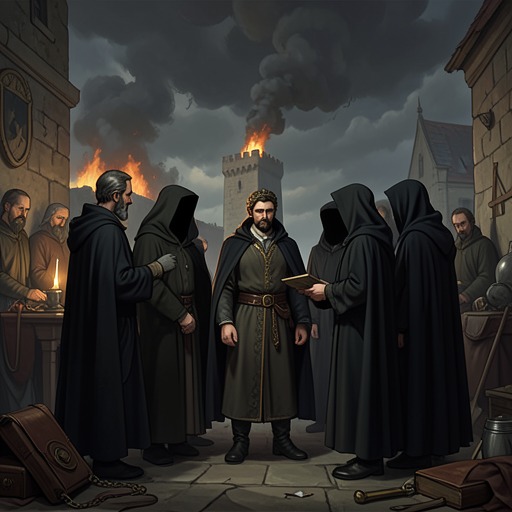
When Borros Baratheon returned to King’s Landing, he moved quickly to re-establish royal control. His forces attacked Gaemon’s position on Visenya’s Hill from three directions, routing the street fighters and mercenaries around the child. Gaemon had celebrated his fifth nameday only two days earlier. He was taken alive and carried back to the Red Keep in chains, weeping, while Essie walked behind him with Sylvenna and the remaining members of his court. The episode ended his rule, but not his life: unlike several adults associated with his court, the child was spared.
Aegon II made that distinction explicit when he judged the three so-called dayfly kings. Trystane was condemned to die, and the Shepherd was also sentenced to death. Gaemon, by contrast, was spared because of his youth and made a ward of the Crown. His mother and Sylvenna were hanged alongside other members of the court. The different outcomes exposed how sharply the restored monarchy separated the child claimant from the adults it held responsible for the disorder.
Several years later, Gaemon’s past briefly entered the question of royal succession. When the regents considered what might happen if Aegon III died without an heir, Aegon put forward his cupbearer, recalling that Gaemon had once been a king. The suggestion was dismissed as impossible. The episode shows that the boy’s former title persisted as a fact in the king’s memory, but it could not make Gaemon a credible successor in the eyes of the governing council.
Companion to Aegon III
Gaemon’s place in the royal household grew more consequential than his short-lived political title. At six, he served Aegon III as both cupbearer and food taster, shared the king’s meals, and often accompanied him to the yard. He was also the only companion the king appeared to care about. The contrast between Gaemon’s low status at court and his importance to Aegon was marked: as a bastard born in a brothel, he counted for little among courtiers, but the king’s attachment gave him a distinctive place in the household.
That closeness was used as an instrument of discipline. Ser Gareth Long, the king’s stern master-at-arms, asked Lord Unwin Peake to make Gaemon Aegon’s whipping boy. Thereafter, when Aegon misbehaved, was lazy, or resisted instruction, Gaemon received the punishment. The account says this reached the king in a way that the master-at-arms’ words had not; Aegon’s conduct in the yard improved, while his dislike of Gareth deepened. Gaemon’s friendship therefore became entangled with court authority: his presence could influence Aegon, but it also made him vulnerable to a punishment intended to control the king.
The two boys’ association endured beyond the yard. Aegon seldom left the Red Keep and had few signs of pleasure in ordinary pursuits; Grand Maester Munkun identified Gaemon as his only friend. After Queen Jaehaera’s death, Mushroom was often in Aegon’s company. His jests failed to dispel the king’s gloom but delighted Gaemon, and Aegon summoned the fool for his friend’s sake. That detail makes Gaemon an intermediary in the king’s limited social world, even though the sources describe the relationship chiefly through the effects it had on Aegon and those around him.
Poisoning and Aftermath
Gaemon died after a supper in Aegon’s solar that he shared with the king, Queen Daenaera, and Mushroom. During the meal he complained of stomach cramps, and Daenaera soon became ill as well. Grand Maester Munkun diagnosed poisoning. The queen was given a purgative and survived, but Gaemon died within the hour. He was thought to be about nine years old. Munkun tested what remained of the supper on rats and determined that the poison had been baked into the crust of the apple tarts; Aegon escaped illness because he was not fond of sweets.
The poisoning produced no reliable resolution. Kingsguard seized people from the Red Keep’s kitchens, and seven captives confessed under torture to plotting against the king. Their accounts conflicted, however: they did not agree about the source of the poison, and none correctly identified the dish. Lord Rowan rejected the confessions as unreliable. The evidence establishes the poisoning and Gaemon’s death, but not who arranged it or whether the intended target was the king, the queen, or both.
Although Aegon had spent less time with Gaemon after Viserys returned to Westeros, the boy’s death left him inconsolable. Viserys broke his silence toward his brother to comfort him and sat with him beside the queen’s sickbed; in that respect, Gaemon’s death helped heal a rift between the brothers. Its broader effect on Aegon was bleak: his old gloom returned, and he seemed to lose interest in his court and kingdom. Gaemon’s life therefore links two very different episodes in the capital—the brief, makeshift kingdom that bore his name and the private friendship that later mattered more to Aegon than the title ever could.